

Green-blue streets: the student designs are evaluated
Green-blue streets:
The student designs
are evaluated
In the past summer semester, lala.ruhr was able to help develop a planning task for the Chair of Landscape Architecture at the RWTH Aachen University. In the project work “green-blue streets – water-sensitive city Essen-Altendorf”, Master’s students of architecture and urban planning designed new neighbourhood models for the densely built-up and densely populated district in the west of Essen. And they did it completely digitally – due to the pandemic, supervision had to take place online and the participants had to make their way individually to site visits.
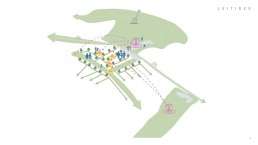
Lecturer Dr.-Ing. Axel Timpe is very satisfied with the results: “Almost all the designs are not only about coping with heavy rain and heat waves, but also about making water visible and designing with water. Questions about embedding in the neighbourhood were well answered.” Significant differences emerged in the design details: the solutions developed ranged from separate sewers and green spaces capable of infiltration to a skate park that can absorb water during heavy rainfall. All designs also integrate the reorganisation of traffic for more liveable street spaces. A sensible approach, says Timpe, because it is clear that green-blue streets must compensate for a loss of parking spaces through new traffic routing and soft forms of mobility such as car-sharing, cycling and e-mobility. These offers and an upgraded public transport system can be found in many drafts.
But how realistic are such approaches in an existing neighbourhood? “The planning focus has long been on aspects of water sensitivity, and not only in new construction projects. We also have to rethink existing buildings in order to meet the requirements of climate change. Of course, we won’t start converting the public space in Altendorf tomorrow in order to install open rainwater drainage or cisterns. However, the student designs can certainly provide innovative approaches, because after the construction of the Niederfeldsee as an overarching green-blue infrastructure, it is important to gradually integrate it into the district in the context of urban renewal,” says Timpe. Also because the artificial lake, which opened in 2014, does not have a constant supply of water, but has to be served by pumps in places – something that could be changed by adapting the structures in the adjacent neighbourhood. “With a neighbourhood by the lake, you’re close to it, and this is exactly where you could start with such measures and thus also check to what extent the ideas can be transferred to the entire urban space. Accordingly, the designs are to be presented to the city of Essen shortly.
lala.ruhr would like to thank the students and the team from RWTH Aachen University and congratulate them on the exciting results.
Übergabe der Handlungsempfehlungen an Nina Freese (RVR, Mitte), durch die lala.ruhr-Initiator:innen Sebastian Schlecht (links) und Melanie Kemner (rechts). Foto: RVR/Volker Wiciok

green-blue streets: planning task at the rwth aachen
green-blue streets:
planning task at the
rwth aachen
green-blue streets: Water-sensitive city Essen-Altendorf. This is the title of a planning task of the Chair of Landscape Architecture at RWTH Aachen University, which was co-developed by lala.ruhr. The project involves the development of a neighbourhood model for liveable, green-blue streets, its elaboration for a street and square space as well as another open space of one’s own choice in the neighbourhood.
The background to the task in the current summer semester: our cities must become more water-sensitive. Under the conditions of climate change, green and blue infrastructure play an increasingly important role in coping with extreme climatic events. In the area of water, this means that public and private open spaces must buffer heavy rainfall events as well as remain attractive during longer dry periods. A gradual conversion is also necessary in the existing city. In addition to the classic green open spaces such as gardens and parks, streets and squares should also be considered for a holistically conceived system of a water-sensitive city. They are the most used public spaces in the city and the capillary vessels of the urban infrastructure, both above and below ground. Liveable streets in a sustainable city should therefore combine many demands: Ensuring traffic and access, absorbing, storing and draining rainwater – at the same time offering residents a beautiful environment and urban flora and fauna a habitat.
The district of Essen-Altendorf, which borders directly on the Niederfeldsee lake, was chosen as an example neighbourhood for the planning task. With the lake and the surrounding areas, a green-blue infrastructure has already been created here, but its integration with the existing city is not yet sufficient. In order to be able to maintain the lake even in dry phases, precipitation water must also be obtained from the neighbouring neighbourhoods in the future. How these can be developed into a blue-green system is being worked out in detail using the example of Weuenstraße and the surrounding area.
We are already looking forward to the students’ designs, which will also be presented here on the blog from the end of July!
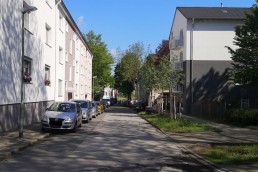
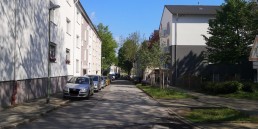
View of Weuenstraße in Essen: Liveable streets in a sustainable city should combine many demands. Photo: Sebastian Schlecht.