
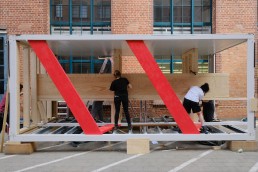
Construction and Renovation for the ZU/FLUCHT Open-Air Exhibition: As part of the project, containers that were originally used as living quarters for refugees were repurposed.
©Natural Building Lab, Berlin
We are nearing the end of our journey through the “waste complex.” Our final topic: Reboot Architecture—circular construction for a sustainable future for our cities. After all, the majority of a building’s environmental impact stems from material consumption. The construction sector generates an enormous amount of unnecessary waste. Wouldn’t it make sense to use materials that are just as durable as conventional ones but can be reused multiple times? And might it even be possible to construct new buildings from “waste”? Yes—the foundation for this is the circular economy, which makes it possible to meet growing resource demands in a lasting and sustainable way. After all, waste doesn’t always belong in a landfill. For example, old wood panels or metals can be repurposed to create new buildings, with clay serving as a versatile “binder.” The “Natural Building Lab” (NBL), a university-affiliated institution at the Technical University of Berlin, carries out such projects. The NBL was founded in 2017 as a research group for “Structural Design and Climate-Responsive Architecture” under the direction of Prof. Eike Roswag-Klinge.
The Natural Building Lab operates as part of a transdisciplinary network that carries out projects applicable to teaching, research, and practice. Working with students is particularly close to their hearts.
The team consists mainly of architects, but is expanded through collaborations with civil engineers, graphic design firms, landscape architects, and communication designers. Their projects clearly focus on natural building materials, clay, and urban timber construction. Most of these materials are sourced from demolished buildings or spaces, because nothing should be thrown away unnecessarily.
ZU/FLUCHT Open-Air Exhibition:
The ZU/FLUCHT project exemplifies the work of the NBL and was carried out as a master’s thesis project with 20 students from the Technical University of Berlin. In collaboration with the Exilmuseum Berlin Foundation, old Tempohome containers (housing for refugees) were converted and redesigned into an extraordinary entrance area for the Exilmuseum, which is currently under construction. The former living spaces were modified using existing materials such as metals (especially sheet metal), wool, and bonded materials. The project aims to stimulate discussion, particularly on the topics of material waste and reuse in the construction sector. The goal was to demonstrate what can be done with old containers, which are often manufactured and then discarded after their primary use. From June to October 2021, the temporary open-air exhibition was on view at Anhalter Bahnhof in Berlin. The planning, construction, and implementation spanned 18 months and were carried out over the course of two semesters at the Technical University of Berlin.
Especially in this era of sustainability, such projects are generating significant public interest, including from the State of Berlin. Circular construction is trending, and “I have a feeling this is becoming the new ‘sustainability,’” says Matthew Crabbe, a doctoral candidate at the NBL. The definition of circular construction is as follows: The proper, circular use of building materials and resources, as well as ensuring they have a long life cycle, promotes cascading use. This involves using renewable, sustainable, or reusable building materials that are climate- and environmentally friendly. The clear focus is on reducing waste and emissions.
Circular construction is supported by the “Cradle to Cradle” (C2C) approach developed in the 1990s by Michael Braungart (a German chemist) and McDonough (an American architect). This approach calls for a comprehensive and consistent circular economy in which all resources are kept within a cycle. The three principles of Cradle to Cradle (C2C) are: waste = nutrient, or in other words, everything is designed as a resource for something else; use energy from renewable sources; and promote diversity.
The goal is for the Rhine-Ruhr region to become a global hub for circular value creation (“Circular Valley”) in the coming years. Circular buildings (structures made from materials and products selected for their reusability) are not yet widespread in North Rhine-Westphalia, with the exception of the Kreislaufhaus at Zollverein in Essen. The new circular administrative building for the RAG Foundation and RAG AG is located at the Zollverein UNESCO World Heritage Site in Essen. The building was designed and constructed by kadawittfeldarchitektur. The materials were selected based on their health and environmental impacts as well as their recyclability. At the end of the building’s lifespan, it is intended to serve as a source of raw materials. The green roofs, urban gardening areas, and animal habitats are also designed to be permanently sustainable. Additionally, “The Cradle,” a seven-story hybrid wood office building, is currently under construction in Düsseldorf’s Medienhafen. The carbon footprint was reduced during construction thanks to the use of wood, a renewable resource. The creation of office spaces also provides economic added value.
We’d like to thank the Theaterallianz Mühlheim an der Ruhr for letting us take over their Instagram channel! We had a lot of fun doing it, and we hope we were able to share new information about waste and the landscape with our readers. So always remember: reuse, reduce, recycle! Not everything you no longer need belongs in the trash! 😉
Writer: Stephanie Stiem
*Starting in January 2022, lala.ruhr will be taking over the Instagram account of vier.ruhr—the alliance of Mülheim theaters—for three weeks. Our theme: the waste complex. We’re taking you on a digital journey through the region and beyond—to places where something is created from waste or where people work with what we colloquially refer to as “trash.” We invite you to think about the urban landscape of the Ruhr Metropolis in circular terms and to discover all materials as part of cycles. We’re featuring the company HeimatERBE, which, among other things, focuses on transforming areas previously viewed by the public as “useless” and enables commercial enterprises to operate in an environmentally neutral way.
vier.ruhr is the theater alliance comprising Theater an der Ruhr, the Mülheim Theater Festival “Stücke,” and Ringlokschuppen Ruhr. Funded as part of the NEUE WEGE program by the Ministry of Culture and Science of the State of North Rhine-Westphalia in collaboration with the NRWKULTURsekretariat.
Construction and Renovation for the ZU/FLUCHT Open-Air Exhibition: As part of the project, containers that were originally used as living quarters for refugees were repurposed.
©Natural Building Lab, Berlin